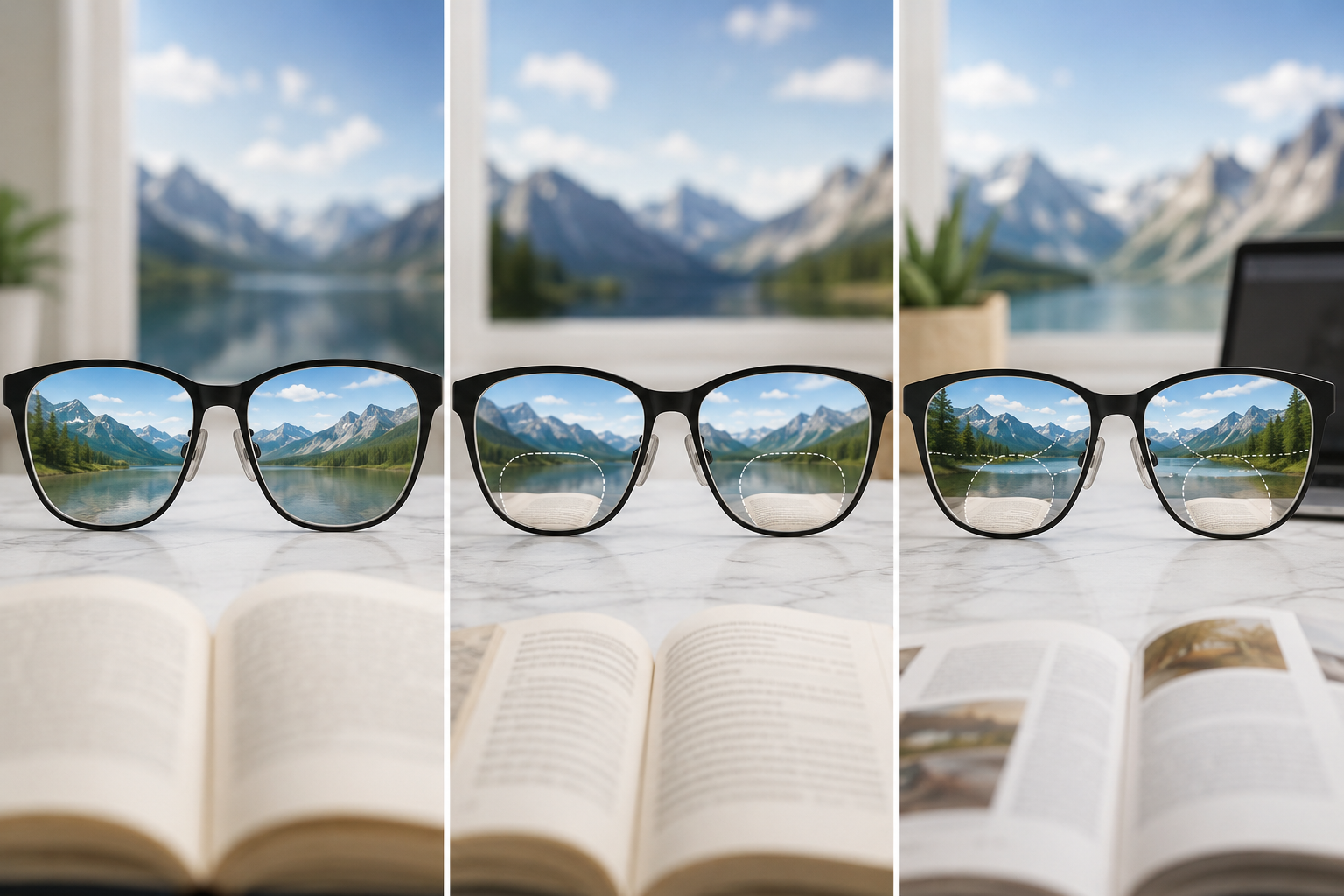
Selecting the correct pair of glasses is more than just choosing a frame that looks nice on your face. The lenses you select will affect how well you see when reading, using a computer, driving, or looking at distant objects. Single vision, bifocal and progressive lenses are designed to meet different vision needs, so understanding the differences can make your purchase much easier.
If you’re visiting a spectacle shop or looking for the best optician in Bopal, knowing the basics will help you to have a more informed conversation about your prescription and lifestyle. Here is a comparison of the three main types of lenses and which might be best for you.
Single Vision, Bifocals, and Progressive Lenses
The difference lies in how each lens corrects your vision at varying distances.
1. Simple and Practical Single Vision Lenses
Single vision lenses have a single power for the whole lens. Depending on their prescription, they are often prescribed for people who need help seeing far away or reading close-up text or looking at screens.
For instance, if a person has difficulty reading road signs, he or she may need lenses for distance correction, or if a person has difficulty reading small print, reading glasses may be useful.
Who should use single vision lenses?
- Persons needing correction for one major viewing distance.
- Students and professionals with prescriptions for distance or near vision.
- People who want simple, easy-to-use eyeglasses.
- People who already own separate glasses for reading and distance vision.
Single vision lenses are usually a cost effective and convenient choice. People who need correction at multiple distances may need separate pairs or a different lens design, however.
2. Bifocal Lenses: One Lens, Two Vision Zones
Bifocal lenses are two different prescriptions in one lens. The upper segment is typically for distance vision, and a separate lower portion is for near tasks such as reading.
They are often used by people with presbyopia, an age-related change that makes it difficult to focus on objects close to the eye. A distinctive feature is the visible dividing line between the two lens sections.
Bifocals can be useful if you frequently go from looking ahead to reading. But they generally don’t have a dedicated intermediate-vision zone, which can be inconvenient for computer users who spend long hours at a desk.
3. Progressive Lenses: A Gradual Transition Between Distances
There are several different prescription strengths of progressive lenses, but there is no visible line separating them the way there is with regular bifocals. Their optical design is a gradual transition from distance correction at the top to intermediate vision in the middle and near vision at the bottom.
Because of this they are a popular choice for people who want a pair of glasses that can be used for driving, computer work and reading.
Progressive lenses are a bit of a learning curve. Some distortion in the periphery or a need to change your head position when looking through different parts of the lens may be experienced, especially for new wearers. Proper fitting, accurate measurements and an appropriate lens design are important to be comfortable.
Single Vision, Bifocal and Progressive Lenses Differences
| Feature | Single Vision | Bifocal | Progressive |
|---|---|---|---|
| Vision correction | One primary distance | Near and distance | Near, intermediate, and distance |
| Visible dividing line | No | Usually yes | No |
| Computer use | Depends on prescription | May be less convenient | Often suitable with proper fitting |
| Adaptation | Usually straightforward | May require adjustment | Often requires an adjustment period |
| Best suited for | Single-distance needs | Two-distance needs | Multiple-distance Needs |
Your prescription, your daily routine, your comfort, and your budget not your age - are what determine the right choice.
Choosing the Right Lens for Your Lifestyle
Think about how you use your eyes all day long before you buy yourself glasses.
If You’re Looking for Distance, or Reading Correction, Mostly
If your prescription is for one main distance, you may only need single vision lenses. They can be particularly beneficial for those who do not need multifocal correction.
When Reading and Distance Are Similar
Bifocals provide two useful viewing zones in one pair of spectacles. They may be suitable for those who want very separate near and distance correction and do not require much intermediate vision.
If You Only Need One Pair for Most Daily Tasks
If you spend your day switching between driving, meetings, computer screens and reading, progressive lenses are worth looking into. A good fit can cut down on the need for multiple pairs of glasses.
When comparing options at a premium eyewear collection, ask about lens materials, anti-reflective coatings, scratch resistance, and available designs. These features affect durability, reflections, and everyday usability, although no coating can eliminate every visual problem.
Important Things to Consider Before You Buy
There should be more to choosing a lens than price comparisons. Keep the following in mind:
- Prescription accuracy: Have your eyes examined by a qualified eye-care professional and use a current prescription.
- Lifestyle needs: Discuss with your optician the amount of time you spend reading, driving or working on digital devices.
- Frame compatibility: The shape, size and depth of the lens of the frame can affect which lens designs are appropriate, particularly for progressives.
- Comfort & Adjustment: Learn about the adjustment period and what to do if your vision is uncomfortable.
- Budget: Look at the overall cost including lenses, coatings, fitting and after-sales support.
If you are looking for an optician near me look for one that explains the options, takes the right measurements and provides advice if you have any fitting or adaptation problems.
Can I Buy Prescription Glasses Online?
Online shopping makes it easier to compare frame styles, lens features and prices. If you’re going to buy branded eyewear online be sure the retailer accepts your prescription and lens type, has clear product specifications and has a return or remake policy in place.
Special care is needed for progressive lenses, and measurements such as pupillary distance and fitting height are important. A prescription is not always enough to obtain all the measures for a perfect fit.
The professional fitting support can be especially helpful for high prescriptions, complex lens needs or first-time progressive wearers. The benefits of online shopping are best realised with reliable measurements and proper after sales support.
Closing Thoughts
Single vision, bifocal and progressive lenses are for different purposes. Single vision lenses are basic for one main distance, bifocals combine near and distance correction, and progressives provide a gradual transition across multiple viewing distances.
Your prescription and daily habits are the first step to making the best decision. Compare the best options, ask questions about the fit and get professional advice before you buy. Good eyeglasses should fit your life as much as your eyes.